Lumber, fire, and rebirth
Lumber country (1850–1912)
The Tupper Lake region was one of the great logging theaters of the Adirondacks. Commercial lumbering around Tupper Lake began around 1850 with the Pomeroy Lumber Company, and the arrival of the Mohawk & Malone Railway in the early 1890s — with its junction at the village of Faust, still called “The Junction” today — turned the area into a booming mill town. The surrounding township, organized in 1890 as the Town of Altamont, was only renamed the Town of Tupper Lake in 2004.[5]
The dominant lumber operator in the country north and east of Big Wolf was the Santa Clara Lumber Company, founded in 1888 by Titus B. Meigs. His son Ferris J. Meigs (Yale, 1889) learned the business in his father's mills and woods, became the company's president in 1911, and led it until it wound down operations in 1941. The company was an early practitioner of what would become scientific forestry — it was noted for planting at least one tree for every tree it cut, and was among the first to prepare and sell processed pulpwood for papermaking.[6] Meigs would prove to be the pivotal figure in Big Wolf's story.
At the turn of the century the lake and its surrounding tract were owned privately — according to the community's own founding memoir, by “a successful retail druggist with several stores located in New York City,” who built a sawmill on the shore of the lake. That mill building survives today, converted into the Big Wolf Club House.[4]
The great fire of 1912
The early 20th century brought catastrophic fire years to the Adirondacks — 1903 and 1908 are the most infamous — driven by drought and the tinder of logging slash left along the new railroads. In August 1912, fire came to Big Wolf. Most of the lake's shoreline forest burned.[4]
Dudley B. Lawrence, Ferris Meigs' brother-in-law and one of the founding campers, left the community's most vivid account of that summer, written from the deck of an ocean liner hundreds of miles offshore:
“When I came on deck I noticed we were proceeding in what seemed to be a fog but was somehow different. I asked one of the officers and he told me that this was no fog, it was smoke from the burning Adirondacks which had blown so far to sea. That very day most of Big Wolf Lake was on fire. It was the end of one era but the beginning of another.” — Dudley B. Lawrence, founding-era camper, quoted in the Big Wolf history preserved by lake families[4]
The druggist-owner, the story goes, was so distraught that he refused ever to visit the lake again. He ordered everything salvageable sold — “even to netting the lake for fish” — and offered what remained at a low price to Ferris Meigs.[4]
Founding a community (1915–1916)
Meigs bought the burned-over lake and its surrounding lands with a plan: sell campsites and rebuild the forest. Lawrence, visiting at Meigs' suggestion around 1915, described “a discouraging outlook… nothing to see except blackened stumps and burned-over hills and fields” — but also the first birches and poplars of second growth pushing up through the ash. Meigs meanwhile was “busily engaging in planting tiny pines, spruce and hemlock on both sides of the road to town and in other parts of the burned-over acres.” The tall trees lining the camp road today are his plantings.[4]
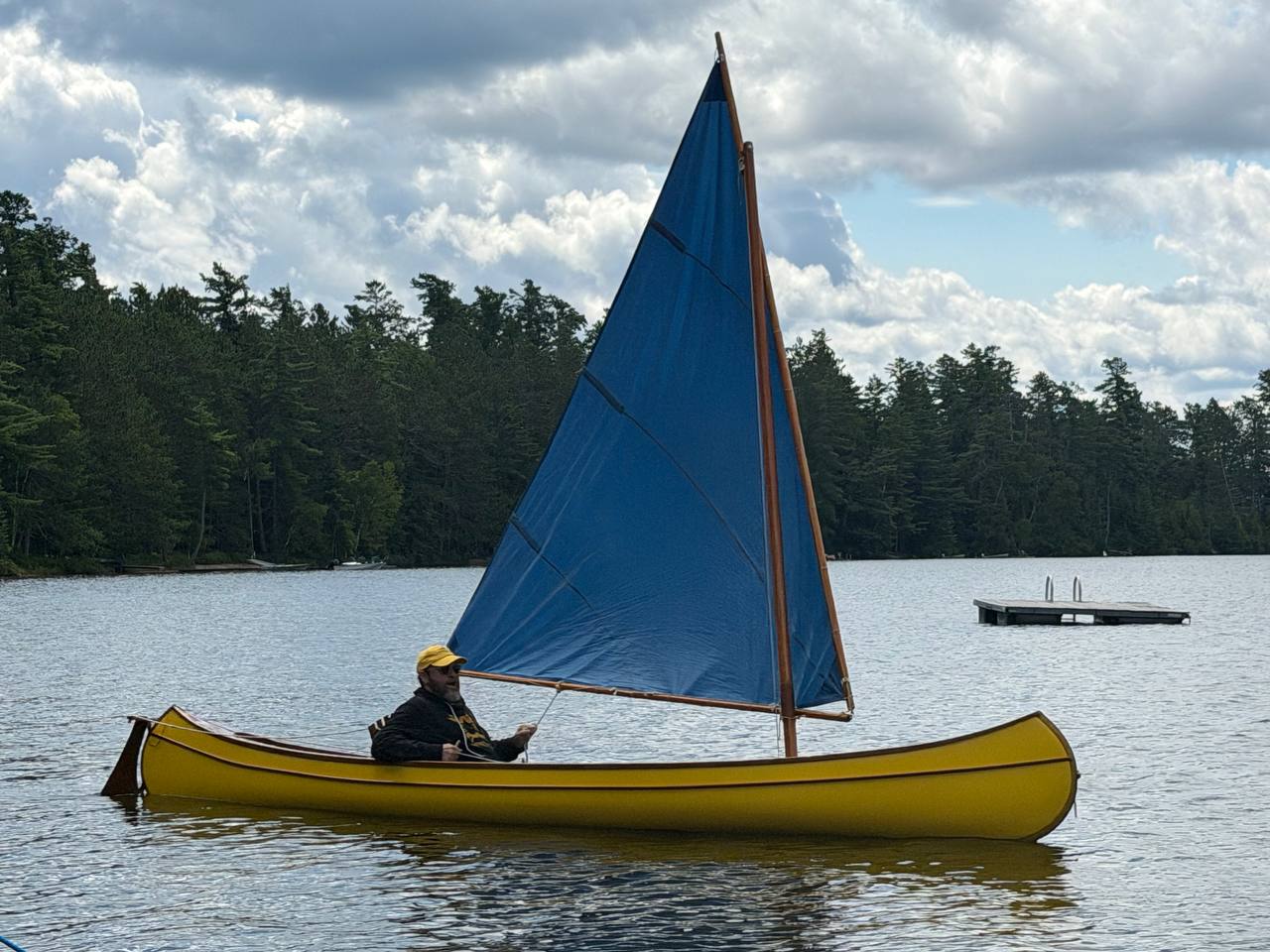
Big Wolf was officially established on July 1, 1916, originally as a community of some 32 families.[4] [7] Early camp life was deliberately primitive: kerosene lamps and candles, ice cut in winter and hauled from the ice house, hand-cranked gasoline motors to pump water, wood-fired kitchen stoves. Electric lines began reaching the camps in 1917. And from the earliest years, the lake developed its signature pastime — the sailing canoe, a tradition Lawrence proudly noted was still going strong four decades later, and which the AARCH architectural tours still remark on today.[4] [2]
Preservation: the Association era
The community Meigs founded matured into the Big Wolf Lake Association, formally organized around 1960, which stewards the lake and preserve today.[7] Its clubhouse — the converted pre-fire sawmill, now more than a century old — remains the social heart of the lake and the keeper of its history.[2] [4] Some thirty-odd member families make up the Association today, under rules designed to keep the water pristine: no off-lake watercraft, trailers, or fishing gear that has been used elsewhere may be brought in — an unusually early and strict invasive-species regime.[3]
The lake's story was set down by Lucia Meigs Andrews — Ferris Meigs' daughter — in her book Big Wolf Lake, 1916–1966, written for the community's fiftieth anniversary, and in her memoir Switchback.[7] [8] Adirondack Architectural Heritage (AARCH), whose founding board president Howard Kirschenbaum has a camp on the lake, has led guided tours of Big Wolf's historic camps by canoe.[2]
More lore
Big Wolf was on the Gilded Age tourist map before it was a community. When Dr. W. Seward Webb's new railroad (the Mohawk & Malone, later the Adirondack Division of the New York Central) opened the region in the early 1890s, guidebook writers traced its route pond by pond — E.R. Wallace's Descriptive Guide to the Adirondacks (1894) told travelers that from Tupper Lake Junction “the line takes an easterly direction past Little Wolf Pond, and turning northerly passes Big Wolf, Rollin's, Floodwood and Long Ponds to Saranac Inn Station.” Passengers bound for the grand hotels of Upper Saranac rolled past Big Wolf's shore two decades before the first camps rose there.[13]
Ferris Jacobs Meigs (1868–1943) was a more complicated public figure than the lake's gentle founding story suggests. A delegate to the 1915 New York Constitutional Convention, he proposed the article placing the Adirondack forests under a commission — and was pilloried for it in the Brooklyn Daily Eagle, whose columnist Julius Chambers branded him “chief of one of the lumber corporations now before the courts for denuding the Adirondack Mountains of their timber.” The same man state forestry officials later complimented publicly for his tree nurseries and replanting — the hands that reforested Big Wolf — spent 1915 being caricatured as a land grabber. His own summer base was White Birches Camp on Follensby Pond, held in the Santa Clara Lumber Company's name.[14]
Meigs also left a memoir of his own — a history of the Santa Clara Lumber Company, serialized posthumously in the Tupper Lake Free Press and Herald in 1970. It preserves, among much else, the drama of the winter of 1898–99: to close the land sale that created the St. Regis Paper Company, young Meigs contracted to sell 58,000 acres of pulpwood land when his company owned only 36,000 — then talked the receiver of a bankrupt neighbor into optioning him the missing 22,000 acres at $2.00 an acre, land he had already sold at $6.00. The gamble carried the company through the bitter split with its senior partner George E. Dodge that followed.[15]
And the lake's architecture is now earning official recognition: in June 2025 the New York State Board for Historic Preservation recommended The Moorings — nominated under the name “Wintergreen,” for the 1965 house William G. Distin designed there at the twilight of his career, alongside the camp's 1918 lake house, beach house, and carriage house by architect Frederick P. Kelley — for the State and National Registers of Historic Places, calling it a rare example of how rustic Adirondack camp architecture evolved into the post-war era.[16]
Timeline
- ~1850Commercial lumbering begins in the Tupper Lake region (Pomeroy Lumber Co.).[5]
- 1888Titus B. Meigs founds the Santa Clara Lumber Company; his son Ferris learns the trade in its mills and woods.[6]
- 1890The Town of Altamont (renamed Tupper Lake in 2004) is organized; the railroad arrives soon after and the mill town booms.[5]
- 1890s–1900sBig Wolf and its tract are held by a New York City druggist, who builds the sawmill that later becomes the Club House.[4]
- Aug 1912Fire burns most of Big Wolf's forest; smoke is visible 600 miles at sea. The owner never returns and sells to Ferris Meigs.[4]
- 1915–16Meigs replants pine, spruce, and hemlock across the burn and lays out campsites.[4]
- Jul 1, 1916Big Wolf officially established — a community of 32 founding families.[4] [7]
- 1917Electric lines begin reaching the camps, ending the kerosene-and-icehouse era.[4]
- 1918The Moorings built on the eastern shore by the Moore family.[2] [8]
- 1925The Quinn Camp built for the Fielder Coffin family, its chimney of cobblestones pulled from the lake bottom.[4]
- 1930Architect Penrose V. Stout and Lucia Meigs Stout build Santa Clara Camp.[8]
- ~1960The Big Wolf Lake Association is formally organized to manage the preserve.[7]
- 1966Lucia Meigs Andrews writes Big Wolf Lake, 1916–1966 for the community's 50th anniversary.[7]
- 2025The Moorings (“Wintergreen”) is recommended for the State and National Registers of Historic Places.[16]
- TodaySome thirty-odd Association families on the 1,100-acre lake and its private preserve; sailing canoes still race; the old mill still serves as clubhouse.[2] [3]